
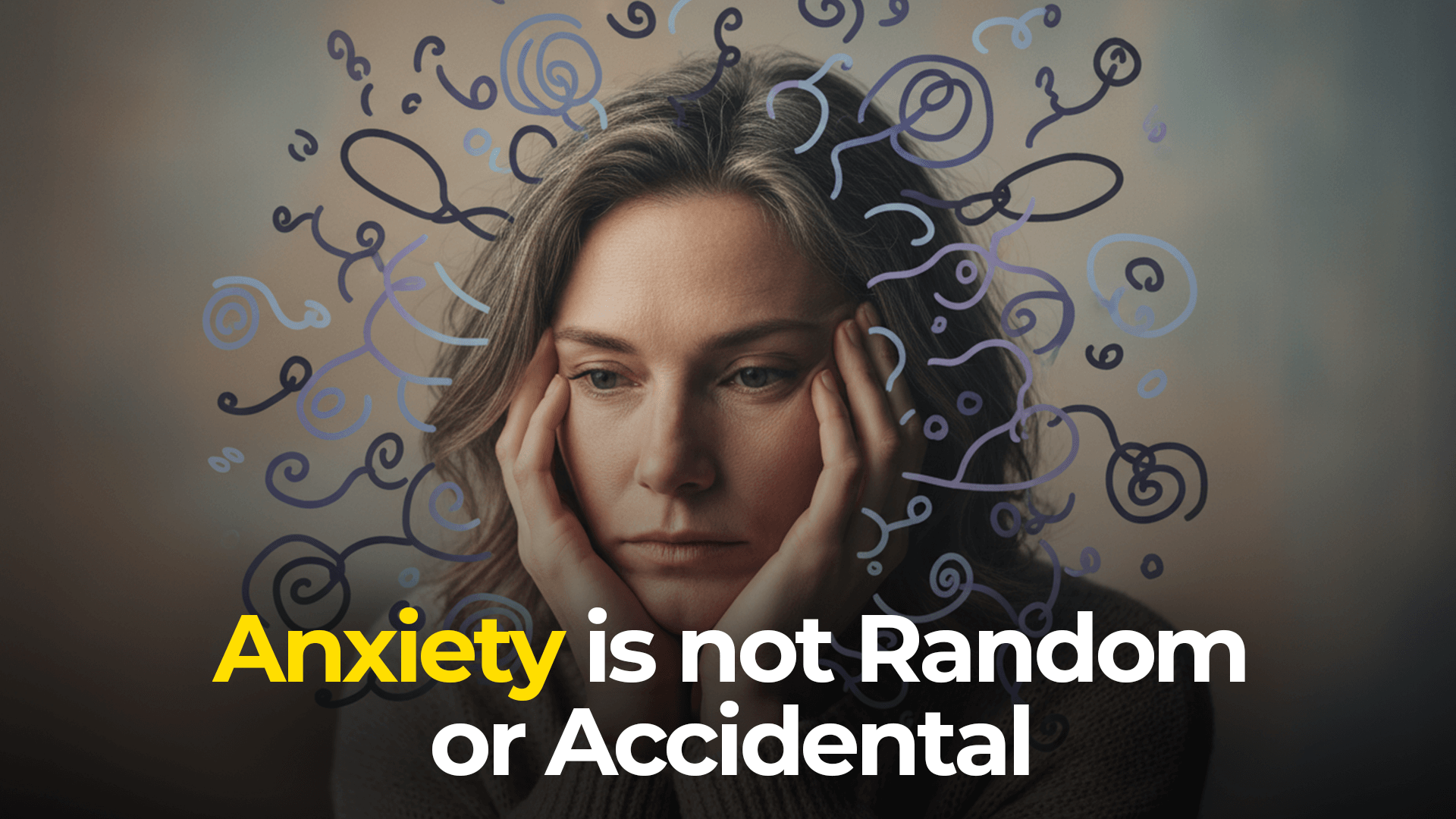
Emotional and Energy Patterns may be screaming to tell you something deeper
You may feel anxious for no reason. But there always is one.
Your heart races without warning.
Your chest tightens at inconvenient moments.
Your thoughts spiral when nothing is visibly wrong.
You do the breathing exercises.
You distract yourself.
You calm yourself down.
Yet, the anxiety returns.
Before reading further, consider these questions:
Q1. Why does anxiety show up even when life seems stable?
Q2. Why do certain situations trigger intense reactions that feel disproportionate?
Q3. Why does stress feel like a baseline instead of an occasional response?
If you connect with these questions, then it is not just about managing anxiety. It is about understanding it.
Anxiety is a Pattern, Not a Personality
Anxiety is often described as a disorder, a weakness, or an overreaction.
But anxiety is rarely random.
It is patterned.
- It follows emotional imprints
- It follows stress memories
- It follows unprocessed experiences
When you look closely, anxiety has themes.
It may intensify around:
- Conflict
- Visibility
- Financial decisions
- Relationships
- Uncertainty
- Success
This is not a coincidence. Your nervous system does not react at random. It reacts based on past stored information.
The Real Causes of Anxiety
When people search for causes of anxiety, they look for immediate triggers such as
- Deadlines
- Work pressure
- Family stress
These are surface triggers, not origins.
The deeper causes of anxiety often include:
- Emotional suppression over long periods
- Chronic hyper-responsibility
- Early experiences of unpredictability
- Feeling unsafe expressing truth
- Growing up in environments where love felt conditional
- Witnessing stress without resolution
The nervous system records these experiences without intellectual analysis.
It does not ask whether the threat still exists. It simply learns.
Later, when life mirrors even a fragment of that old environment, anxiety activates immediately.
Emotional Imbalance Is Stored in the Body
Anxiety is not just mental. It is physiological.
It shows up as:
- Tightening of the chest
- Shallowed breathing
- Digestive discomfort
- Restlessness
- Sudden fatigue
- Insomnia
These sensations are not random. They are stress patterns.
When emotional imbalance remains unresolved, the body compensates by staying alert.
Alertness leads to hyper vigilance. And, hyper vigilance leads to chronic anxiety.
You believe that you are overthinking. In reality, your body is protecting you.
Stress Patterns Become Identity
Over time, prolonged stress starts to feel normal.
You start describing yourself as:
- An anxious person
- A worrier
- Highly sensitive
- Always on edge
But anxiety is not who you are. It is how your nervous system adapted.
If your system learned that unpredictability equals danger, it will search for danger.
If your system learned that mistakes equal rejection, it will anticipate mistakes.
These are intelligent survival responses, which become problematic when they outlive the original threat.
Why Anxiety Persists Even After Therapy or Self-Help
Many people attempt to manage anxiety through mindset work.
- They reframe thoughts
- They practice affirmations
- They try positive thinking
These methods offer relief. But, anxiety still returns.
Why?
Because emotional patterns are not stored only in thought. They are stored in the nervous system and the energy body.
You cannot logic your way out of a stress response your body still believes is necessary.
Insight helps. Integration heals.
The Energy Dimension of Anxiety
Beyond psychology and biology, anxiety too has an energetic imprint.
When fear or stress is repeated, it leaves contractions in the energy field.
These contractions influence:
- How you respond to opportunity
- How much ease you allow
- How comfortable you feel with uncertainty
- How safe expansion feels
You may consciously desire calm. Yet unconsciously, your system equates calm with vulnerability.
This is why anxiety increases at times when life slows down.
Stillness removes distraction. Stored energy rises.
High Functioning Anxiety Is Often Misunderstood
Some of the most successful individuals experience anxiety intensely.
They perform well.
They meet deadlines.
They appear composed.
Yet, internally they experience:
- Racing thoughts
- Constant tension
- Difficulty relaxing
- Fear of underperforming
- Over preparation
High functioning anxiety is not visible chaos. It is internal pressure.
Because the performance remains high, the anxiety goes unnoticed or unaddressed.
Over time, this unaddressed anxiety leads to emotional exhaustion.
What Your Anxiety Is Trying to Tell You
Anxiety is also a form of communication.
It may be telling you:
- You are carrying too much alone
- You are ignoring boundaries
- You are suppressing anger or grief
- You are operating from old survival roles
- You are pushing beyond your nervous system capacity
Anxiety is rarely the enemy. It is the alarm.
The mistake is to silence the alarm without checking the cause.
The Cycle of Suppression and Escalation
When anxiety appears, many people try to eliminate it quickly.
They distract.
They numb.
They push through.
This creates a cycle:
- Stress builds
- Anxiety signals
- Suppression occurs
- Signal intensifies
The body escalates when unheard.
Over time, the mild discomfort becomes a major cause of panic.
Regulation Is Different from Avoidance
Managing anxiety is not about removing fear. It is about teaching the nervous system about safety.
Regulation includes:
- Slowing the breath intentionally
- Extending the exhale
- Grounding awareness in the body
- Reducing overstimulation
- Allowing emotions to move instead of suppressing them
Regulation tells the body:
- I am not under threat
- I can stay here
- I am safe
This shifts the internal baseline gradually.
Anxiety and Control
Many anxiety patterns are tied to control.
When life feels uncertain, the mind attempts to manage every outcome.
Overthinking becomes preparation.
Perfectionism becomes protection.
But control requires energy.
When control fails, anxiety increases.
Sustainable calm does not come from controlling more. It comes from building tolerance for uncertainty.
That tolerance is a nervous system skill.
Why Identifying the Pattern Matters
Trying to eliminate anxiety without understanding its pattern creates resistance.
When you identify:
- What triggers it
- Which emotions sit underneath
- Which memory it mirrors
- Which belief it protects
You begin cooperating with your system instead of fighting it.
Awareness reduces threat perception. Compassion softens intensity.
Integration releases repetition.
What Real Healing Looks Like
Healing anxiety does not feel dramatic. It feels gradual.
You may notice:
- Fewer spikes in reactivity
- More recovery time after stress
- Greater tolerance for discomfort
- Clearer decision-making
- Less need to control
Calm becomes familiar.
Expansion stops feeling dangerous.
The system updates.
The Cost of Ignoring Anxiety Patterns
Untreated anxiety does not disappear.
It often transforms into:
- Fatigue
- Irritability
- Emotional numbness
- Digestive issues
- Sleep disruption
- Burnout
The longer emotional imbalance remains unaddressed, the more it spreads across systems.
The body always communicates.
The question is whether you are listening.
A Grounded Way Forward
If anxiety has been a recurring theme in your life, neither is it random nor is it proof of weakness.
It is information.
When emotional and energy patterns are identified at their root, anxiety shifts from being an enemy to being a guide.
You do not need to eliminate sensitivity.
You need to regulate and realign.
Address Anxiety at Its Root, Not Its Surface
Anxiety is not a flaw in your personality. It is a pattern stored in your nervous system and energy field.
Dr. Chandni Tugnait works at the intersection of emotional intelligence, nervous system regulation, and energy psychology to identify the root causes of anxiety and the stress patterns sustaining it.
Through a guided session and Aura Scan process, we uncover where emotional imbalance is stored, how your system interprets safety, and what is preventing calm from feeling natural. Connect with Dr. Chandni Tugnait’s support team at +918800006786 or by clicking here and book an appointment.
Because when the pattern is understood, anxiety stops feeling unpredictable.
If your anxiety is not random but a coded message from your system, how much longer will you treat the symptom instead of decoding the signal?
Frequently Asked Questions
Q1. What are the most common anxiety root causes?
A. Common anxiety root causes include unresolved emotional stress, early life unpredictability, chronic hyper-responsibility, emotional suppression, and long-term nervous system dysregulation. These factors create stored stress patterns that activate repeatedly.
Q2. Can anxiety exist without an obvious trigger?
A. Yes. Anxiety can be activated by internal memories or emotional imprints rather than present-day events. The nervous system reacts to stored patterns even when no visible threat exists.
Q3. How does emotional imbalance contribute to anxiety?
A. Emotional imbalance creates physiological stress responses. When emotions are not processed or expressed, they remain stored in the body, contributing to chronic tension and anxiety symptoms.
Q4. Why does anxiety return even after therapy?
A. If therapy addresses cognition but not somatic and energetic storage, anxiety patterns may persist. True resolution requires nervous system regulation and emotional integration.
Q5. What are stress patterns?
A. Stress patterns are repeated physiological and emotional responses to perceived threat. They become automatic over time and shape the body’s reaction to situations.
Q6. Can high-functioning individuals still struggle with anxiety?
A. Absolutely. High-functioning anxiety often remains hidden because performance is maintained. Internal pressure and hypervigilance may persist despite outward success.
Q7. How does nervous system regulation reduce anxiety?
A. Regulation teaches the body that it is safe. When the nervous system exits survival mode, anxiety responses become less frequent and less intense.
Q8. What role does energy healing play in anxiety management?
A. Energy healing addresses stored contraction and emotional imprints beyond conscious thought. It complements psychological work by releasing patterns held in the subtle body.
Reach Dr. Chandni’s support team at +918800006786 and book an appointment.





























 facebook
  X
X  youtube
  whatsapp
  instagram
  linkedin